Last Updated: November 1, 2026
Quick Summary
To find your fit in faith-based apparel, measure a shirt you already own flat across the chest and from shoulder to hem, then match those numbers to the product's garment size chart rather than your usual letter size. Prioritize chest width for unisex tees and body length for oversized cuts, and size up one for layering, shrinkage, or an oversized look.
- A unisex medium and a women's medium are not the same shirt.
- Measure a shirt you love, not your body, and compare to the chart.
- For a fitted unisex tee look, size down one from your women's size.
- Size up one for oversized fits, layering, or 100% cotton shrinkage.
- Wash cold and dry low to protect both the fit and the print.
Table of Contents
- Why Faith-Based Apparel Sizing Trips Up Online Shoppers
- How to Read a Christian Apparel Size Chart
- How to Measure for a T-Shirt at Home
- How to Choose a Hoodie Size That Layers Right
- Getting the Oversized Christian T-Shirt Fit on Purpose
- What Fabric, Washing, and Shrinkage Do to Fit
- Between Sizes? Use This Decision Checklist
- Shop Essential Kingdom Apparel With Your Measurements Ready
- Frequently Asked Questions
Why Faith-Based Apparel Sizing Trips Up Online Shoppers
Unisex cuts are often cut to menswear proportions, which explains much of the faith-based apparel sizing confusion.
Faith-based apparel sizing trips people up because many brands sell unisex garments cut to menswear proportions, a women's medium and a unisex medium are not the same shirt.
Most guides hand you one rule ("size down") and call it done, but guidance varies by brand and garment.
Below, we'll show you how to read a size chart, measure yourself at home, and pick the right size the first time.
How to Read a Christian Apparel Size Chart
A Christian apparel size chart lists garment measurements, not body measurements. That distinction is the whole game: the numbers describe the shirt lying flat, so your job is to match them to a shirt you already own and love.
Christian apparel sizing guidance from Rooted in Scripture recommends starting with the item-specific chart rather than assuming all cuts fit alike. That advice holds up.
The three numbers every chart is really showing you
Most charts list the same core measurements but label them inconsistently. Confirm which of these three you are reading:
- Chest width (armpit to armpit). Measured flat across the chest, usually one inch below the armhole seam. This is a half-circumference: 22 inches across the chest describes a garment with roughly a 44-inch full chest.
- Body length. From the highest point of the shoulder, next to the collar, straight down to the bottom hem. This decides whether a tee covers your waistband or rides up when you sit.
- Sleeve length. From the shoulder seam to the sleeve opening for set-in sleeves, or from the center back of the collar for raglan cuts. Raglan and drop-shoulder garments are measured differently, so a sleeve number will not translate cleanly between charts.
If a chart lists a full chest circumference instead of a flat chest width, halve it before comparing it to a flat-lay measurement of your own shirt. Mixing the two is the most common chart-reading error.
How to measure a shirt you already own
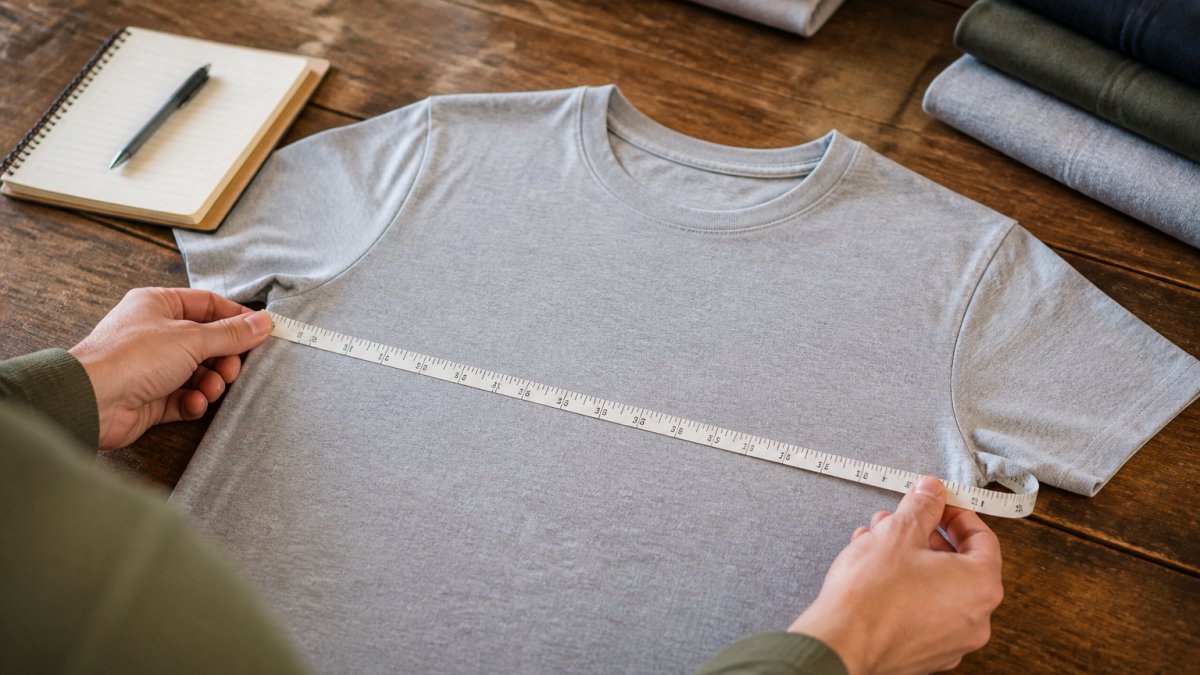
You do not need a body measuring tape or a second person. Lay a shirt that fits you well flat on a table and take three measurements:
- Chest width. Armpit seam to armpit seam, straight across, one inch below the armhole, tape parallel to the hem.
- Body length. From the highest point of the shoulder, beside the collar, straight down to the bottom hem.
- Sleeve length. Shoulder seam to sleeve opening for a set-in sleeve; for a drop-shoulder or raglan tee, center back of the collar to the sleeve opening.
Write the three numbers down, then repeat on a second shirt you like, ideally in a different fabric weight. Two data points show the range you actually find comfortable.
Match the numbers, not the letter
Once you have your three measurements, find the chart row whose chest width and body length land closest to your own shirt. Do not start from the letter size you usually buy, letter sizes drift between brands and cuts.
A unisex medium tee and a women's medium in a fitted cut can differ noticeably in chest width and body length, so always check the specific product chart.
Chart-reading by garment type
The same chart-reading method applies to every garment, but the numbers you prioritize change by cut:
- Unisex tees. Prioritize chest width. Shoulders run wider and the body longer than a women's cut in the same letter. For a fitted look, size down one from your women's size; for relaxed, stay at your usual letter.
- Women's-cut tees. Prioritize body length and chest width together, a chart that matches your chest may still come up short on a longer torso.
- Hoodies and sweatshirts. Prioritize chest width and add an inch or two for layering; heavyweight fleece has less give than jersey.
If you want to practice the method on a specific garment, see our Jesus saved my life tee.

How to Measure for a T-Shirt at Home
Here's the full walkthrough, step by step:
- Pick your best-fitting shirt. Not your favorite design, your best fit.
- Lay it flat. Smooth out wrinkles so the fabric sits even.
- Measure chest width. Armpit seam to armpit seam. Write it down.
- Measure body length. Highest point of the shoulder to the bottom hem.
- Measure sleeve length if it matters. Shoulder seam to the sleeve end.
- Repeat with a second shirt. Two data points beat one.
- Compare both to the chart. Choose the size that lands closest.
A common mistake is measuring your body and comparing it to garment numbers. A 40-inch chest does not mean you need a 40-inch chest width on a flat-lay chart.
How to Choose a Hoodie Size That Layers Right
Choose a hoodie size based on what you'll wear underneath it. Layering over a long-sleeve tee: go with your measured size.
Fabric weight matters here too. Our Unisex Heavy Blend hoodie uses a medium-heavy 8.0 oz/yd² cotton-poly blend with a classic fit.

Before you order, check three things on the product page:
- Fabric weight. Heavier fabric drapes less and fits closer to the chart.
- Fit label. "Classic fit" and "relaxed fit" are not the same cut.
- Size options. Confirm your size is in stock before you plan the outfit.
If you're still deciding which hoodies deserve that level of care, our guide to quality faith-based hoodies for every day covers what separates a hoodie that layers well from one that bunches up.
Watch out: ordering a hoodie in your T-shirt size and expecting the same fit. The two garments are cut differently, and the hoodie will feel snug through the shoulders.
Getting the Oversized Christian T-Shirt Fit on Purpose
An oversized Christian T-shirt fit should look intentional, not accidental.
Jesus saved my life-Unisex Heavy Cotton Tee →
The oversized look works when the shoulders drop slightly and the body stays long enough to cover your waistband. Size up twice and you get a tent.
Three rules keep it clean:
- Size up one, maximum. Two sizes up rarely photographs well in person.
- Keep the hem below the waist. Check the body length on the chart before you commit.
- Balance the volume. Pair a loose tee with a fitted bottom half.
A faith graphic shirt in a relaxed fit reads as a deliberate style choice. The same shirt two sizes too big reads as a mistake.
What Fabric, Washing, and Shrinkage Do to Fit
Cotton can shrink. If you want to learn how to judge fabric quality and construction so you can anticipate shrinkage and fit changes, see our guide on how to identify high quality apparel.
Fabric composition tells you how much movement to expect:
| Fabric | Shrink Risk | Feel | Best For |
|---|---|---|---|
| 100% cotton | Higher | Soft, breathable | Everyday tees |
| Cotton-poly blend | Lower | Smooth, holds shape | Hoodies, sweatshirts |
| Heavier cotton (200 GSM+) | Moderate | Substantial, structured | Premium tees |
A 2026 apparel guide from IGIT Apparel's fabric weight guide notes that T-shirts typically start at 180 GSM, with heavyweight options at 200 GSM or more.
Wash cold, dry low. Those two habits help protect both the fit and the print.
Between Sizes? Use This Decision Checklist
When you are between sizes, the right answer depends on three things: how you want the garment to fit, whether you plan to layer under it, and how much the fabric is likely to shrink. Run through this decision path before you check out.
Step 1: Decide the fit you actually want
Pick one target before you look at the chart again:
- Close fit. Skims the body with little extra room. Choose this for women's-cut tees and any knit with stretch.
- Classic fit. A little room through the chest and body, sleeves ending at the wrist bone. The default for most unisex tees and hoodies.
- Relaxed fit. Noticeably roomy through the chest and shoulder, hem still below the waist.
Step 2: Weigh layering
Ask what will be worn underneath the garment on a normal day:
- Nothing or a thin tee. Stay at your measured size for a classic fit.
- A long-sleeve tee. Stay at your measured size for a tee; size up one for a hoodie or sweatshirt.
- A thick sweatshirt or fleece. Size up one for a hoodie or sweatshirt. Fleece has less stretch than jersey, so the chart number is closer to the fit you actually get.
Step 3: Factor in shrinkage
Fabric composition decides how much the fit will move after the first few washes:
- 100% cotton. Expect a small amount of shrinkage in body length and chest width after hot washing and high-heat drying. If you are between sizes and want a classic fit, size up one.
- Cotton-poly blend. Less shrink, more shape retention. Stay at your measured size unless you want extra room for layering.
- Heavier cotton (200 GSM or more). Shrinks less dramatically than thin cotton. Stay at your measured size for a classic fit.
Wash cold and dry low to protect both the fit and the print. Those two habits do more for long-term fit than any single sizing decision.
Step 4: Run the decision tree
Work through these questions in order and stop at the first one that matches your situation:
- Do you want an oversized look? Size up one from your measured size. Stop here.
- Will you layer a thick sweatshirt or fleece underneath? Size up one. Stop here.
- Is the garment 100% cotton and you want a classic fit that survives washing? Size up one. Stop here.
- Do you want a close fit in a women's-cut tee or a stretch knit? Stay at your measured size. Stop here.
- Still split between two sizes? Size up one. A slightly roomy tee looks better than a tight one, and it leaves room if the fabric shrinks.
Inclusive sizing and body-shape considerations
Standard size charts are built around a single set of proportions, and most bodies do not match that set exactly.
Some faith apparel sellers offer plus-size and curvy-fit collections, and Elly and Grace's plus-size collection is one example of a brand building sizing around different body types. If a brand's chart stops at a certain size, that tells you something about who they designed for.
A note on international size labels
If you are comparing a chart from a brand that uses international sizing, treat the letter or number label as a starting point only. A US medium, a UK medium, and an EU medium are not the same garment, and conversion tables vary by brand. Measurements in inches are the only reliable common language across regions.
Shop Essential Kingdom Apparel With Your Measurements Ready
You now have the numbers. Grab your chest width and body length, open a product page, and match them to the chart.
Our collection combines modern style with biblical truth, designed to help you express your faith in your daily life.
Ready to find your fit? Check each product's chart against the measurements you just wrote down.
Frequently Asked Questions
How do I measure myself for a T-shirt?
Lay a T-shirt that fits you well flat on a table. Measure across the chest from armpit to armpit, then double that number for the full chest width. Measure from the shoulder seam down to the hem for shirt length, and from the shoulder seam to the sleeve end for sleeve length. Compare those numbers to the size chart for the specific garment you want. Measuring a shirt you already own is more reliable than measuring your body, because it accounts for how you actually like a shirt to sit.
Do faith-based apparel brands use standard sizing?
No single standard applies across faith-based apparel brands. One brand's medium can match another brand's large, and unisex cuts often run about one size larger than women's cuts. The reliable move is to check the Christian apparel size chart for the exact garment you are buying, since a T-shirt, sweatshirt, and hoodie from the same seller can each fit differently. Treat any general rule as a starting point only, then confirm against the item-specific measurements.
Should I size up for an oversized Christian T-shirt fit?
Size up one step from your measured size for a relaxed, oversized look, and two steps only if you want a deliberately loose drape. Check the shirt length as well as the chest width, because sizing up adds length too, which matters if you plan to wear it untucked. If you want the oversized Christian T-shirt fit without swimming in fabric, pick a style cut with a relaxed silhouette and stay at your normal size.
What should I do if I am between clothing sizes?
Go with the larger size when the garment is 100% cotton and you plan to machine dry it, since cotton can shrink after the first few washes. Choose the smaller size if the fabric is a cotton-polyester blend that holds its shape and you prefer a closer fit. Also factor in layering: a hoodie worn over a tee needs room in the chest and shoulders. When in doubt, compare the flat measurements of a shirt you already love against the chart before ordering.
Sizing shouldn't be the reason a shirt you love sits in a drawer. At Essential Kingdom Apparel, we build premium faith-based apparel with modern designs and biblical truth, and we want every garment to fit the way you hoped. Check the chart, measure your best-fitting shirt, and order with confidence. Get started with Essential Kingdom Apparel and wear your faith with the fit it deserves.
